


Seyfert galaxies have been among the most intensively studied objects in astronomy. A massive black hole in the nucleus of a galaxy, accreting gas from its surrounding environment, is thought to be the power source. We do not see the black hole itself, but the UV continuum radiation is generally presumed to be thermal emission from the hot gas that forms an accretion disk surrounding the black hole. In addition, very broad emission lines are observed, which are thought to come from clouds somewhat farther away, moving at velocities of order These broad-line clouds are photo ionized and heated by the extreme-UV radiation from the central source, resulting in the strong, broad resonance Lyman
 line emission observed from hydrogen. The permitted lines also sometimes show narrower cores, and there are also narrow forbidden lines, which are thought to arise from more distant, lower density, photoionized gas in a narrow-line region.

 The broad-line component dominates the spectra of quasars and type 1 Seyfert galaxies, while the narrow-line component dominates in type 2 Seyferts. It is widely believed that the objects may be basically similar, but that obscuration of the central region as viewed from certain directions may hide the continuum and broad-line regions in type 2 Seyfert galaxies, leaving a clear view of only the narrow-line region. The luminosity of Seyferts is typically
  making the tiny nuclear region as luminous as an entire galaxy of stars, and the inferred mass of the central black hole is
 . Small values of these parameters are associated with low-luminosity Seyferts, and large values are thought to characterize the rarer, high-luminosity quasars.
The far-UV spectral region is of fundamental importance in determining the nature of all these active galactic nuclei. The UV continuum radiation may arise in an accretion disk very close to the black hole, while UV emission and absorption lines provide the best diagnostics of the surrounding material in the broad- and narrow-line regions. Consequently, observations of Seyfert galaxies and quasars were a goal of one of the major observational programs for HUT on Astro-1.
One of the brightest and best-studied Seyfert galaxies is NGC 4151. It has been classified as type 1.5, showing the characteristic features of both types 1 and 2. The UV spectrum is illustrated below.
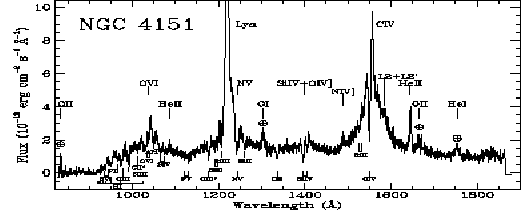
Below 1200 Å, a region in which no Seyfert galaxy has previously been observed, there is strong emission in the OVI doublet and a very complex absorption-line spectrum.
The strongest absorption lines include the Lyman series of hydrogen, as well as features due to CIII and NIII and higher ionization states, up to NV and OVI. All of the absorption lines are blueshifted, with respect to the galaxy rest frame, by several hundred km/s, and they appear to have intrinsic widths of about 1000 km/s. The UV continuum disappears completely below 924 Å, owing to strong absorption by overlapping Lyman lines. The ratio of the strengths of the CIII 977 Å line and the1176 Å line (which arises in an excited state) indicates densities in the absorbing gas greater than Such high densities are characteristic of the gas in the clouds that yield broad emission lines.