A particle does not occupy a fixed, definite position in space. It is smeared out over a definite none zero volume in the form of a wavepacket.
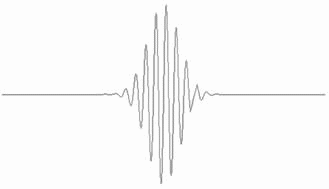
In general the wavepacket is made of of many differentfrequencies or wavelengths. They interfere constructively in the region of the particle and destructively outside it. Different parts of thewavepacket will in general travel at different velocities, with the velocity dependant on frequency or wavelength. This means that the wavepacket will spread out as it travels. We can derive the'disperson relation' from the wavefunction obeyed by the particle.
The basic, non – dispersive wave equation is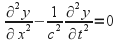 or
or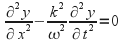 (1)in one dimension. This equation is obeyed only by ideal waves –which have no weight, for example. Electromagnetic waves travelling through a vacuum obey this form of wave equation.
If the conditions of ideality do not apply, for example if the wave is carried by a string which is not perfectly flexible, then we will need to introduce a term proportional to displacement with a negative coefficient. The wave equation becomes 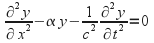 (2)
(2)
or the wave is moving through a resistive medium, so experiences damping, we need to introduce a term proprtional to with a negative coefficient. The wave equation becomes
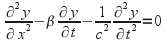 (3)
(3)
The dispersion relation is found by substituting the solution for the undamped wave equation (1)  (4) into (2) or (3). Dividing by the exponential factor leaves the dispersion relation.
For the first example (2)
Differentiating (4) gives
Subsitution into (1)

Dividing by the non zero gives
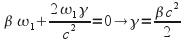
gives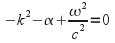 or
or
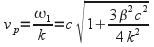
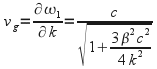
The phase velocity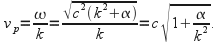 and the group velocity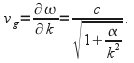
For the second example (3)

Dividing through by asbefore gives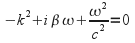 Thecomplex factor here is a problem. It means that either
 or
or is complex. Because we included a damping or resistance ter mdifferentiated with respect to time, I will assume it isthat is complex, that


Cancelling the exponential term gives
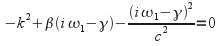
Equating the real parts gives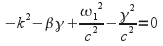
Equating imaginary parts gives