


Apparatus:
Two retort stands/clamps/bosses, two metre rulers, stop watch, two lengths of cotton thread.
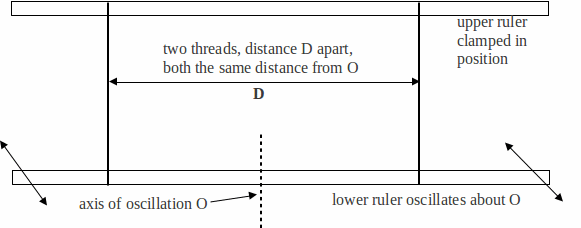
Procedure:
1. Set up the above apparatus with two lengths of thread of equal lengths (approx. 30cm).
Do not tie the threads too tightly as you will need to vary the distance during the experiment.
2. Record distancein cm, which should initially be about 60cm..
3. Set the lower ruler into oscillation in such a way that it oscillates about a VERTICAL axis at O.
4. Use your stop-watch to record the time, in seconds, it takes the lower ruler to complete one oscillation. You should do this by measuring the time for at least 10 complete oscillations. However, if the total time is less than 10 seconds you should use more than 10 oscillations.
5. Repeat the above for five more different values of
6. Tabulate your results and include two extra columns showing the logarithms of bothand
You should label these columns as and
and
Note it does not matter which 'log' button you use ('ln' or 'lg') as long as you always use the same one. Do not worry if some of the log values are negative.
7. Plot a graph ofagainst
8. Measure the gradient, and calculate the
 - axis intercept,
 of your graph.
9. The period of a bifilar suspension is expected to be given by an equation of form
Where that depends on the other physical properties of the set up (e.g. the mass of the lower ruler). The values of
 and the power
 can be found by the method you have used (see full theory below).
Read the theory below and state what values you have found for&
Theory:
If:
Taking logs on both sides of the equation yields:

This has the form of where the gradient
 and the intercept